
'For this kind of informal summit, I think it is better to leave the leaders much time to discuss whatever they would like to discuss'
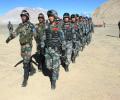
Indian and Chinese troops remained engaged in an eyeball-to-eyeball situation in several disputed areas.
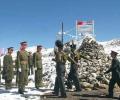
People familiar with the situation in the region said the two sides were engaged in trying to resolve the dispute, but there was no indication of a positive outcome yet as both the armies continued to bolster their positions in disputed areas of Pangong Tso and Galwan Valley and Demchok.

'(The) PM has surrendered Indian territory to Chinese aggression. If the land was Chinese: Why were our soldiers killed? Where were they killed,' he asked on Twitter, tagging the prime minister's remark.

'A firm national resolve can only deter and defeat the nefarious designs of the adversary,' notes Rup Narayan Das.

'Both have a very nationalistic view of foreign policy.' 'They think they are shrewd and clever diplomats.'
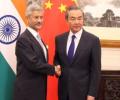
Wang said the two sides should follow the important consensus reached by the leaders of the two countries and strengthen the communication and coordination on the proper handling of the border situation through the existing channels so as to jointly maintain peace and tranquility in the border area, the Chinese foreign ministry said in a statement.

Xi will attend the second informal meeting with Modi at Mahabalipuram near Chennai from October 11 to 12 and pay a state visit to Nepal on October 13, Foreign Ministry spokesperson Hua Chunying announced on Wednesday.
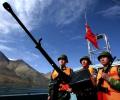
Both the Indian and Chinese armies have brought in more troops in sensitive locations like Demchok, Daulat Beg Oldie and areas around Galwan river as well as Pangong Tso lake in Ladakh, the sources said. The area around Galwan has been a point of friction between the two sides for over six decades.
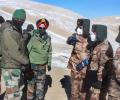
"The meeting thus did not result in resolution of the remaining areas," the Army said in a statement.
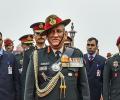
The creation of a CDS has got the head right. Issues that were not talked about for years are now being discussed, points out Ajai Shukla.

China is spending billions of dollars to improve infrastructure in Tibet and other parts of its border with India. Claude Arpi explains why New Delhi can't afford to ignore Beijing's plans.
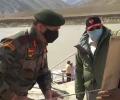
'We should not minimise the seriousness of Chinese encroachments because their perception is different.' 'Nor should we fall into the trap of accepting so-called 'buffer zones' in areas of overlapping claims. We cannot have buffer zones in our own territory,' asserts Ambassador Shyam Saran, a former foreign secretary.
The talks between the two armies are going to be held this week at multiple locations including Patroling point 14 (Galwan area), Patrolling point 15, and Hot Springs area, top government sources said.
The Chinese side has particularly bolstered its presence in the Galwan Valley, erecting around 100 tents in the last two weeks and bringing in heavy equipment for construction of bunkers, notwithstanding the stiff protest by Indian troops. There have been reports of multiple incidents of transgressions by Chinese troops in several areas in Eastern Ladakh.

Sheela Bhatt, who is travelling with Prime Minister Manmohan Singh on his two-nation visit, analyses the outcome of crucial talks between the PM and his Chinese counterpart in Beijing.

'Tibetans will participate in future conflicts with India (in all probability, some were already present in Galwan).' 'As nobody in India would like to have a deadly fight with Tibetan soldiers and officers, the issue needs to be closely followed,' observes Claude Arpi.

'All the government needs to do is to identify clear political and strategic objectives and to give the military planners a free hand,' asserts Ajai Shukla.

'He is psychologically preparing the PLA and the Chinese public to avoid a loss of face.'

Giving an account of India's overall military modernisation, Lt Gen Pande also said that an in-principle approval has been given to new combat formations called the Integrated Battle Groups (IBGs) which can mobilise fast with a more effective approach.
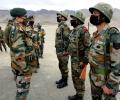
'India is not the India of 1962. We are not carrying that baggage of history anymore.'

This was the first round of talks for Wang after he succeeded State Councillor Yang Jiechi earlier this year.

'We can't be outliers. We can't be bystanders. We have to be players.' 'The Taliban also need India to balance the winners in this game.'

'The government will ensure that India's pride is not affected as far as the situation along Indo-China border is concerned'

'The Panchsheel Agreement is unique in the annals of international relations as it stands out as a bizarre illustration of a prime minister trading his country's crucial national interests solely to buffer his personal international image,' feels R N Ravi.

India has over 4,000 medium tanks, but not a single light tank. It remains to be seen whether the Ladakh face-off with China galvanises a change, observes Ajai Shukla.

Four Chinese soldiers were killed in the fierce clash with the Indian Army in the Galwan Valley in eastern Ladakh in June last year, the People's Liberation Army (PLA) acknowledged for the first time on Friday.
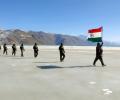
India has told China not to "shift goalposts" and "confuse" managing the border affairs and restoring peace at the frontiers with the larger issue of the resolution of the boundary question, which is dealt with by different designated mechanisms.

In spite of irritants and hiccups in the relationship, a few deliverables are expected of the prime minister's visit to China, says Rup Narayan Das.
'The world does not care about the tension on our border.' 'India has to emerge as a strong economic power.' 'Respect comes when the world sees a country with a direction and leadership that has a vision,' points out Ramesh Menon.
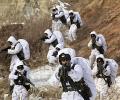
In all the noise surrounding the Dok La confrontation, Claude Arpi focuses on a crucial issue that has hardly been covered -- the construction of roads for the armed forces and the local population to reach the most remote border posts.
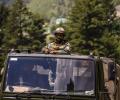
'Our biggest advantage is that the troops are much better trained and motivated than the Chinese and can improvise and manage with a part of the resources.'

On the border dispute, officials on both sides say the protracted boundary talks made progress, while both sides made attempts to avert tensions along the 3,488-kilometre-long Line of Actual Control, which remains undefined.
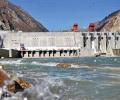
"The reservoir capacity of the project is less than 0.02 per cent of the average annual runoff of the Yarlung Zangbo-Brahmaputra. It cannot have an adverse impact on the downstream," Chinese foreign ministry said to a question on concerns over the dam.

Besides the border question, India and China discussed issues related to counterterrorism including Beijing's blocking of India's bid in the United Nations to ban Pakistan-based JeM chief Masood Azhar, National Security Advisor Ajit Doval said on Thursday.

Being a pragmatist Modi is not likely to give preference to China over Japan. Both security and economic aspects are likely to shape Modi's decision in terms of engaging the two biggest economies of Asia, says Sana Hashmi.

'As for tricky relations with China, India needs less of summitry type event management and more anticipatory analysis and management of events,' says Ambassador Jaimini Bhagwati.

'It will be a repeated folly to ever think that China will not attack us.'

India and China on Friday agreed to seek a "political" solution to the border dispute at the earliest as Prime Minister Narendra Modi asked Beijing to "reconsider its approach on some issues" and announced CBMs like e-visa for Chinese tourists and operationalisation of hotline between two militaries.

India and China met and spoke a lot this year, but failed to produce any meaningful results.
 © 2026 Rediff.com - Advertise with us - Disclaimer - Privacy Policy - Sitemap - Feedback - About us - Terms of use - Grievances